
Therapeutic writing doesn’t begin with knowing what to say.
It begins with creating enough space for something to appear.
There are days when writing flows easily, and days when the page feels distant or even intimidating. On those days, writing prompts aren’t meant to push words out of you. They exist to open a door — gently, without force.
These therapeutic writing prompts in this article aren’t designed to solve anything. They don’t promise healing, clarity, or emotional breakthroughs. Instead, they offer starting points. Invitations to notice what is already present, without demanding explanation or resolution.
You don’t need to write well.
You don’t need to finish what you start.
You only need to listen.
What Makes a Writing Prompt Therapeutic?
Not every writing prompt is therapeutic.
A therapeutic writing prompt doesn’t aim for productivity, creativity, or insight. It doesn’t lead you toward a conclusion or ask you to “fix” anything. Its purpose is quieter than that.
A therapeutic prompt:
- allows uncertainty
- respects emotional limits
- doesn’t assume readiness
- leaves room for silence
Rather than directing you toward answers, it helps you notice what’s already there. Sometimes that’s an emotion. Sometimes it’s resistance. Sometimes it’s nothing at all — and that matters too.
Therapeutic writing isn’t a replacement for therapy.
I came to understand this more clearly during my first 30 days of writing, when showing up mattered more than insight.
It doesn’t regulate intense emotional material or provide professional support. What it can do is help you stay connected to your inner experience between moments of guidance and care, without forcing you to explain or interpret what you feel.

How to Use These Prompts Safely
Before starting, it helps to slow down.
Therapeutic writing works best when it feels contained, not overwhelming. You don’t need to treat these prompts as assignments or challenges. Think of them as options — available, but not required.
A few grounding reminders before you begin:
- You don’t have to answer a prompt fully
- You can stop at any point
- You can skip any prompt without explanation
- You can write a sentence, a fragment, or a single word
If prompts tend to open things quickly for you, it may help to write within a familiar routine, or to return to them during weekly reflection rather than all at once.
There’s no right pace here.
Only a respectful one.
This is where structured journaling can offer a sense of safety without pressure.
When Writing Prompts Are Most Helpful
Writing prompts are especially useful during moments when free writing feels inaccessible.
This might be when:
- your thoughts feel scattered
- emotions feel present but undefined
- writing feels important, but hard to begin
- you want to stay connected without going too deep
In these moments, prompts can act as gentle anchors. They offer direction without pressure and give you something to respond to when the page feels too open.
Prompts don’t replace intuition — they support it when it feels quiet or distant.
Research on expressive writing suggests that structured emotional writing can support stress reduction and emotional processing. Prompts work in a similar way: they provide a light framework that helps the mind organize what the heart is trying to say.
I often notice this more clearly during weekly reflection, when patterns have time to surface.
Why Prompts Can Feel Safer Than an Empty Page
An empty page can feel limitless.
And sometimes, limitlessness is overwhelming.
When everything is possible, nothing feels clear.
Therapeutic writing prompts create gentle boundaries. Not restrictions — boundaries. They narrow the focus just enough to keep the nervous system from feeling flooded.
Structure doesn’t remove emotion.
It contains it.
For many people, especially those who carry unprocessed grief or long-held silence, containment is what makes reflection possible.
The prompt becomes a doorway with edges.
You step through it knowing where the frame is.


30 Therapeutic Writing Prompts
You don’t need to do these in order.
Choose what feels approachable today.
Prompts for Emotional Awareness
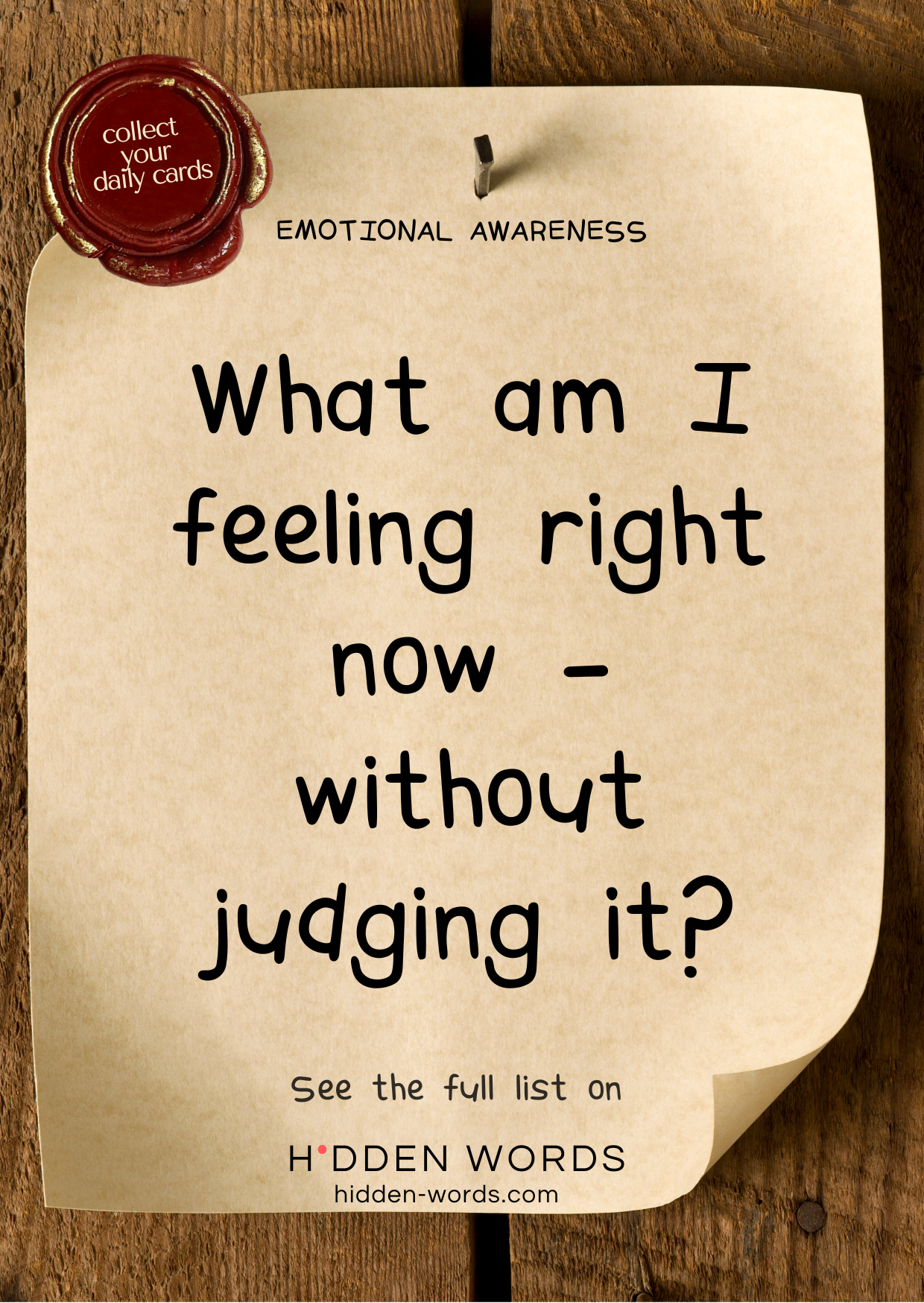
- Right now, the emotion I notice most is…
- An emotion I’ve been avoiding lately is…
- Something that feels heavier than I expected is…
- If my body could describe today, it would say…
- An emotion that surprised me recently was…
Prompts for Processing Difficult Moments
- Something that stayed with me longer than I thought is…
- A moment I keep replaying is…
- What feels unfinished right now is…
- If I didn’t have to explain myself, I would say…
- What I wish someone had noticed is…
Prompts for Self-Compassion
- Something I’ve been hard on myself about is…
- A part of me that needs gentleness today is…
- If I spoke to myself the way I speak to others, I would say…
- What I did my best with — even if it didn’t work out — was…
- One thing I don’t need to fix right now is…
Prompts for Letting Go
- Something I’m holding onto that feels heavy is…
- A belief I’m slowly questioning is…
- What I no longer want to carry alone is…
- If I allowed myself to release one thing, it would be…
- Letting go doesn’t mean losing — it means…
Prompts for Inner Reflection
- A younger version of me might need to hear…
- Something I learned about myself recently is…
- A pattern I’m beginning to notice is…
- When I feel safest, I tend to…
- A boundary I’m becoming aware of is…
Prompts for Grounding and Presence
- Right now, what feels stable in my life is…
- Something small that brought relief recently was…
- When I slow down, I notice…
- A moment from today that felt real was…
- If I could thank myself for one thing, it would be…

What to Do After You Finish a Prompt
Sometimes the most important part of therapeutic writing happens after the sentence ends.
You close the notebook.
You look around the room.
You notice your breathing.
Before moving on, it can help to pause.
You might ask yourself:
- What feels different right now?
- Do I feel lighter, heavier, or simply clearer?
- Do I need rest, or do I feel steady?
Therapeutic writing isn’t only about expression. It’s about integration.
A small closing ritual — a glass of water, a short walk, a deep breath — can signal to your nervous system that it is safe to settle.
Writing opens.
Closing gently matters too.
When Writing Prompts Feel Like Too Much
There will be days when even gentle prompts feel overwhelming.
That doesn’t mean you’re doing something wrong. It often means that something inside you needs rest rather than expression.
On those days, it’s okay to:
- write only one word
- rewrite the prompt without answering it
- close the notebook without writing anything
Therapeutic writing isn’t about pushing through resistance.
Learning to stop with care became part of how I practice writing with self-worth.
It’s about listening to that resistance. Sometimes the most supportive response is to stop — and that choice is part of the practice.
How These Prompts Fit Into a Healing Writing Practice
Writing prompts are tools, not obligations.
They can be used:
- between therapy sessions
- during weekly reflection
- when free writing feels inaccessible
- as a gentle way to reconnect with yourself
Writing this way also helped me understand how different forms of grief can appear quietly, without a single defining moment.
Some people return to the same prompt many times. Others move through them quickly. There’s no correct way to engage.
If you’re building a regular practice, structure can help prompts feel safer rather than overwhelming. A familiar beginning and ending can turn prompts into invitations instead of demands, especially when emotional material feels close to the surface.


“Do these really help?” I made a doubtful face while scrolling. “Ugh — whatever. I’ll try it. What could possibly go wrong?”
Lizy, from an upcoming novel
How to Know a Prompt Is Working
A therapeutic writing prompt doesn’t always lead to insight.
Sometimes it leads to discomfort.
Sometimes it leads to silence.
Sometimes it leads to a sentence that feels unfinished.
A prompt is working when it helps you notice something — even if that something is resistance.
You might notice:
- a shift in your breathing
- a memory surfacing unexpectedly
- a sentence that feels honest but unfamiliar
- an emotion that doesn’t need explanation
Therapeutic writing prompts aren’t measured by how much you write.
They’re measured by whether they help you stay connected to yourself, even briefly.
You Don’t Have to Use All 30
Thirty therapeutic writing prompts might sound like a lot.
You don’t have to move through them quickly.
You don’t have to finish them in a week.
You don’t even have to finish a single one.
Sometimes a single prompt can stay with you for days.
Sometimes you return to the same question again and again, and it opens differently each time.
A healing writing practice isn’t about completion.
It’s about returning — gently, consistently, and without forcing clarity before it’s ready.
A Gentle Closing Thought
The final week of the 30 days wasn’t about revelations.
You don’t need to answer all 30 prompts.
You don’t need to answer any of them perfectly.
If one sentence helps you notice something you hadn’t named before, that’s enough.
Therapeutic writing doesn’t begin with the right words.
It begins with the willingness to listen.
Frequently Asked Questions About Therapeutic Writing Prompts
Next read soon:
→ 50 Deep Journal Prompts for Letting Go of Unspoken Emotions
Save on Pinterest: